The 3 Things That Make Your Team Actually Adopt AI
Teams are not slow. They are perfectly happy to adopt anything that is obviously better. Almost nothing they get shown clears that bar. Here is what does, and what I have watched it do to a room.



Corporate teams are not slow to adopt AI. They are perfectly happy to adopt something that is clearly, obviously, undeniably better. The problem is that almost nothing people show them clears that bar. And there is a reason for that.
We have all seen teams be reluctant to use AI. Too stuck to their old ways. I have watched it happen in the room, in the trainings I run for different companies, and I want to tell you what I actually saw in there.
At the beginning I thought people were just resistant to change. I was wrong. That was not what was happening at all.
Every time I have seen a team really adopt AI, with real motivation, real implementation, real transformation, it is because one of the three pillars below changed something in their heads. Exactly one of these three things. Sometimes two. Sometimes all three. Anything else gets you ah, how cool. And that is cool changes nothing. They go back to their old way on Monday, because their old way works and they are good at it.
What every one of them needed was a real aha moment. Once they get it, their whole approach flips, and they suddenly become AI first.
So how do you get there? Never talk about how incredible AI is. Never show off all the awesome stuff it can do. Instead: read the team. Make them tell you how they work. Walk through their routines. Then look for one of these three pillars of AI value, in order of importance.
ON AIR CH 01 · 01:18Whenever you train a team or a business owner, ask yourself one question: what could AI do here to amplify their talent, to multiply their impact, or to heavily cut their manual, time consuming processes, to leave space for the activities they are irreplaceable at?
The three pillars of AI value
Amplify their talent
THE MESSAGE IS NEVER “AI CAN DO WHAT YOU DO”
The creative team that found a door inside its own technique
Take a corporate marketing team. The message is not “AI can do marketing like you do.” It is this: you are already a great creative team. Now let me show you what happens when we take your same creative techniques and run them through this workflow.
We combine them with a model that takes the design you just made and drops it into another asset that lives on your brand's TikTok, with the character featured on your brand's Instagram, using a cutting edge prompting technique from 2026.
What they saw: their own talent, the design assets they make by hand, amplified and multiplied across creative uses they had not imagined.
 CH 01 · AMPLIFY
We opened a new door, and it starts inside their own creative technique. We are not pretending to substitute them. We are amplifying what they can already do.
It is not AI doing their job. It is AI making them better at the job they are already proud of.
Multiply their impact
THE STRONGEST ONE, FOR MY MONEY
This is the strongest one for me.
The anti AI coach who went all in
A vocal coach I worked with. Completely reluctant to adopt AI. She came to me overloaded: she needed content for her socials and had no time. Hours in Canva for one carousel. Four or more takes in an afternoon for a thirty second reel. And she was tired of generic AI, the kind that hands you a generic post about vocal coaching.
So we built a system that takes the content of her masterclasses and sessions and turns it into workbooks, blog posts, Instagram carousels and reels. Enriched with her own knowledge. Written in her exact tone, because we built a tone agent that analysed all of her posts. Designed in her brand colours and her brand structure. Voiced with a clone of her real voice, using her own image. It posts everything automatically, stories included. It even replies to comments, and it sells her vocal coaching course.
What she saw: a self described manual first, anti AI person when we met, going all in.
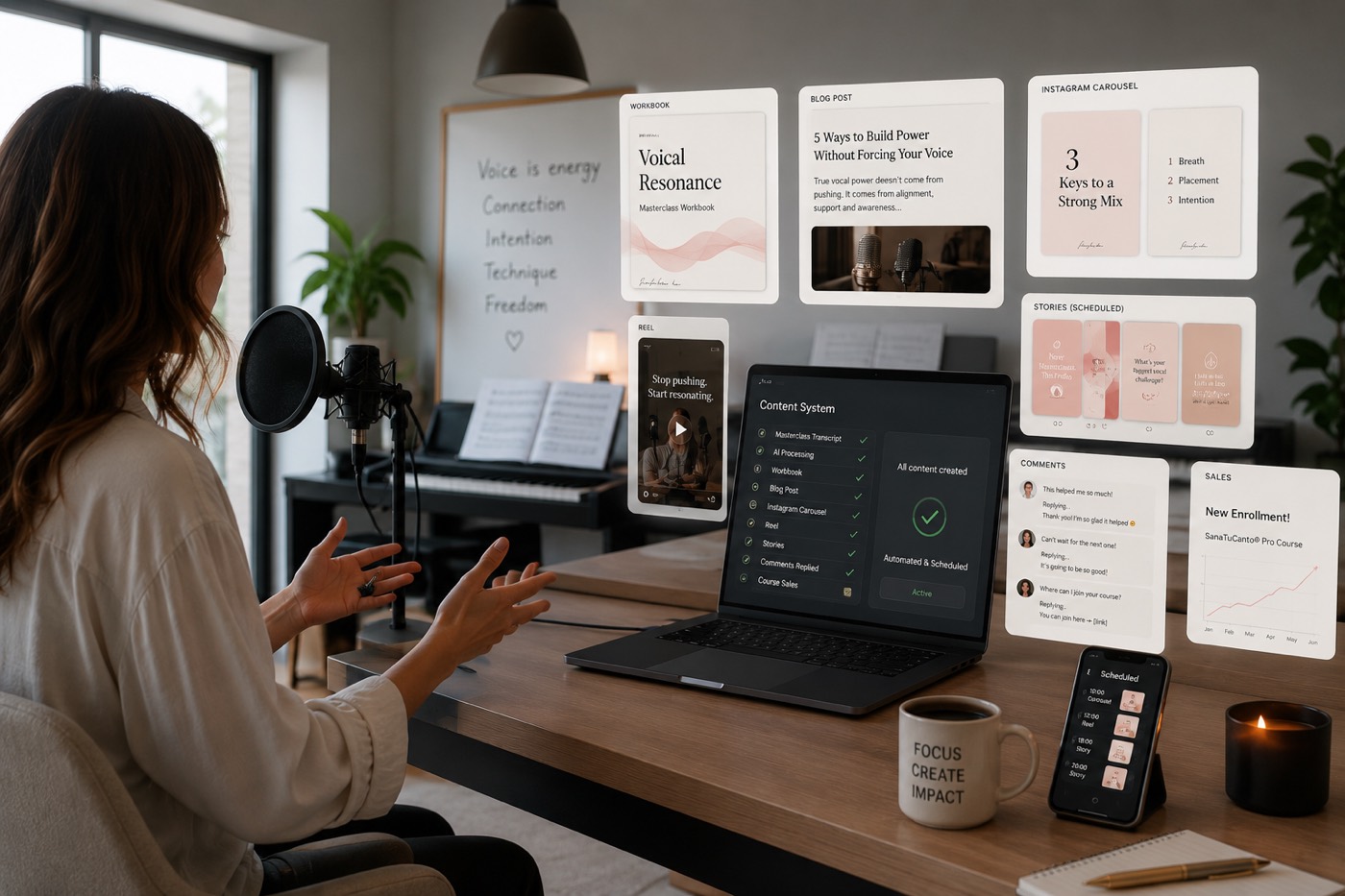 CH 02 · MULTIPLY
She is not generic, and she is not replaced. She multiplied her impact with her own methodology and her own talent, at a scale she could never reach by hand, all from a lesson she had just taught.
That is what made her go all in. Not the technology. Her own work, everywhere at once.
Cut the manual labour, to make time for what matters
NOT “SAVE TIME”. MAKE TIME.
Not “save time”. Cut the manual work hard, to make time for the things that matter.
Find the boring, manual, soul draining part of the job and cut it, with a goal in mind: what is left is the part they are irreplaceable at. The part that needs real human judgement. The part they actually enjoy.
The team whose job got more human, not less
I worked with a team that manually filtered and then analysed influencer profiles. The filtering was pure drudgery. The analysis was deeply human, and they were genuinely great at it. Then they sent dozens of personalised emails, by hand.
So we built the whole workflow with a manual step left in the middle: AI filters and qualifies, the humans get the shortlist and review it, and the outreach goes out personalised and in the right tone, automatically.
The result: more qualified people entering the pipeline, and more human work at the stage where humans win. Their job got MORE human, not less. That is when they adopted it.
 CH 03 · CUT
The solution was never to automate the whole workflow. It was to take out everything purely manual and boring, so they could concentrate on the part that needed human judgement, which happened to be the only part of the job they truly enjoyed.
The fear nobody says out loud
There is a second thing going on in these rooms, and it is quieter.
AI is here to replace me.
A few months ago management brought me in to build an automation for a team. From the first session something felt strange. The information they gave me was subtly wrong. Just wrong enough that the automation would not really be useful. I realised what was happening, corrected it quietly, and said nothing.
When I delivered it and they saw it actually working, they went into overdrive, visibly racing to prove to their bosses that they could be faster than the machine.
They never said it. I could feel it: this thing is here to take my job.
And here is what I have learned about that fear. You do not argue it away. You dissolve it with the third pillar.
What motivated that team was not reassurance. It was seeing, concretely, that once the manual work was gone, they got to spend their whole day doing the exact thing they are irreplaceable at. The thing they are great at. The thing they never had enough hours for. That is where the implementation worked.
You cannot feel replaced by something that hands you more of the work you are best at.
The accountant's Excel can be automated. What cannot be automated is the criteria: the judgement that turns a pile of spreadsheets into a real decision about where the business makes money, what to do more of, what to stop.
ON AIR CH 04 · 03:07Every role has that core. Find it, name it out loud, and build the automation around it instead of at it.
What this means in practice
- Never demo generic capability. Demo their work. Their process, their brand, their voice, their actual bottleneck.
- If the reaction is just “ah, that is cool”, you are not yet in the right spot. If the reaction is “wait, wait, is this for real”, you are getting close.
- Find what each person is proud of, and protect it. That is the thing AI amplifies and never absorbs.
- Name the fear out loud before it goes underground. Unspoken it becomes bad inputs and quiet sabotage. Spoken it becomes a conversation, and then a demo that answers it.
- AI is not here to replace the worker. It is here to get the most out of people: free them from everything eating their time, and amplify the talent that cannot be replaced.
Put humans where they are best. Hand the rest to the machine. That is the whole framework. And honestly, it is the only version of this I want to be promoting.
Find the core of the job, name it out loud, and build the automation around it, not at it.